

The Science Behind Neuro Progeny
Training resilience and reliability for increased nervous system capacity
The Science Behind the Tech
Your nervous system shapes how you respond to pressure, relationships, and everyday demands, often before conscious thought catches up. Neuro Progeny uses real-time biofeedback to make those internal shifts visible as they happen, so regulation becomes something you can practice and learn, not something you have to force. This is the foundation of moving beyond survival, escaping stress, and living on purpose.
What we measure and train
Resilience is your ability to recover after stress and return to steadiness.
Reliability is your ability to access regulation consistently, so your best self is available when it matters.
Together, these build capacity, which means more adaptive range, more choice, and less internal cost.
On this page, we explain the science behind how we measure and train both resilience and reliability in real time. Capacity is the foundation that makes resilient recovery possible and reliable regulation sustainable.
Why real-time feedback matters
Most tools give you a number after the fact. Real-time feedback shortens the learning loop. You can see what your system is doing in the moment, then learn what actually helps you shift, recover, and return to a steady state.
Why We Measure Heart Rate Variability (HRV)
Heart Rate Variability (HRV) is the variation in time between heartbeats. It is a widely used biomarker in psychophysiology research because it reflects autonomic nervous system adaptability, including how the body responds to stress and returns to baseline.
In simple terms, HRV gives us a window into capacity. It helps us understand how much adaptive range your system has available in a given moment.
When HRV patterns support regulation, people often experience:
better recovery after stress
improved sleep and restoration
greater emotional flexibility
clearer thinking under pressure
When HRV patterns reflect strain, people often experience:
chronic stress activation
reduced recovery capacity
increased mental and emotional effort
difficulty downshifting into rest and recovery
HRV is not a single “health score,” and it must be interpreted in context. We use it as a real-time mirror that helps people learn what supports regulation and what increases internal cost.
In this model, HRV helps us see capacity, which is what resilience and reliability draw from when life gets demanding.
Why HRV Alone Is Not Enough
HRV is a powerful signal, but it does not tell the whole story.
HRV helps us understand capacity, meaning how much adaptive range your nervous system has available. But capacity does not always equal stability, clarity, or ease in real life.
Two people can have similar HRV readings and very different lived experiences:
One may feel grounded, steady, and clear
Another may feel wired, foggy, reactive, or inconsistent
This can happen because a nervous system can have capacity without coordination. In those moments, the system may be working hard to stay functional, even if the numbers look “fine.”
That is why we do not treat HRV like a score to optimize. We use it as part of a larger picture that helps us understand not only how much capacity is available, but how usable and reliable that capacity is under real-world demands.
That is why we train reliability directly. We want regulation to be accessible on purpose, not only when conditions are easy.
What We Train Alongside HRV: Nervous System Coordination
Capacity matters, but coordination is what makes capacity usable.
In addition to HRV, we track real-time pattern features that reflect how organized your nervous system is while you are thinking, feeling, and responding. This helps us see whether regulation is happening through integration and recovery, or through effort, tension, and over-control.
In simple terms:
HRV reflects capacity (how much adaptive range you have)
Coordination reflects usability (how stable and accessible that range is)
Coordination is what turns capacity into reliable access. It is the difference between sometimes feeling regulated and being able to return to steadiness when it matters.
When coordination improves, regulation becomes more reliable. You can return to steadiness faster, stay present longer, and recover with less internal cost.
This is the foundation of resilient, reliable flow.
Why Real Time Training Works
Most people already know what they “should” do. The problem is that nervous system patterns run faster than conscious awareness.
A thought hits.
A story forms.
The body shifts.
Attention narrows.
And by the time you realize what is happening, you are already inside the pattern.
Real-time biofeedback shortens that delay.
When you can see your internal state shift as it happens, you build three trainable skills:
Notice sooner (earlier awareness)
Recover faster (resilience)
Return to regulation on purpose (reliability)
The goal is not to eliminate activation. It is to restore choice, so you can stay steady and clear under real-world demands.
Mind, Body, and Emotional Alignment in Practice
Most people do not struggle because they lack insight. They struggle because the nervous system runs patterns automatically and faster than conscious awareness.
A trigger happens.
A story starts.
The body shifts.
Attention narrows.
And by the time you realize what is happening, you are already inside the pattern.
This is why willpower is not the answer. You cannot think your way out of a nervous system state. Real change happens when the mind and body start working together again, in real time.
With biofeedback, participants can see their internal state shift as it happens. That makes it easier to connect what is happening mentally and emotionally with what is happening physiologically, without self blame or over analysis.
Over repeated practice, alignment becomes more reliable. Regulation becomes less effortful. Choice returns sooner. That is what resilient, reliable flow looks like in everyday life.
This is how we move beyond survival, escape stress, and live on purpose, with more clarity and less internal cost.
Why We Use Virtual Reality (VR)
Virtual reality is used because it can change how the nervous system learns, not just what it learns.
The brain is constantly predicting what will happen next based on past experience. VR can create a novel sensory environment that interrupts familiar patterns and increases attention, presence, and embodied awareness.
That matters because regulation is not built through insight alone. It is built through repeated experiences where the body learns, in real time, what it feels like to shift states and return to steadiness.
Why this is different from typical biofeedback
Many biofeedback tools provide numbers, graphs, or summaries after the fact. This experience is different because the feedback is real-time and experiential.
Participants see changes in their physiological state as they are happening, while they are engaged in the practice. This makes it easier to connect what they are doing internally with how their nervous system is responding, without having to interpret data later.
The emphasis is on learning and awareness, not tracking or optimizing metrics.
Why we combine biofeedback with VR
XRegulation is embedded in a virtual reality environment to strengthen attention, presence, and embodied learning. When real-time biofeedback is paired with immersion, participants can practice regulation while the nervous system is actively responding, which supports faster pattern recognition and more reliable state shifting.
Rather than training a single metric, we focus on building both capacity and coordination so resilience and reliability improve together.
What the Data Shows (Preliminary Results)
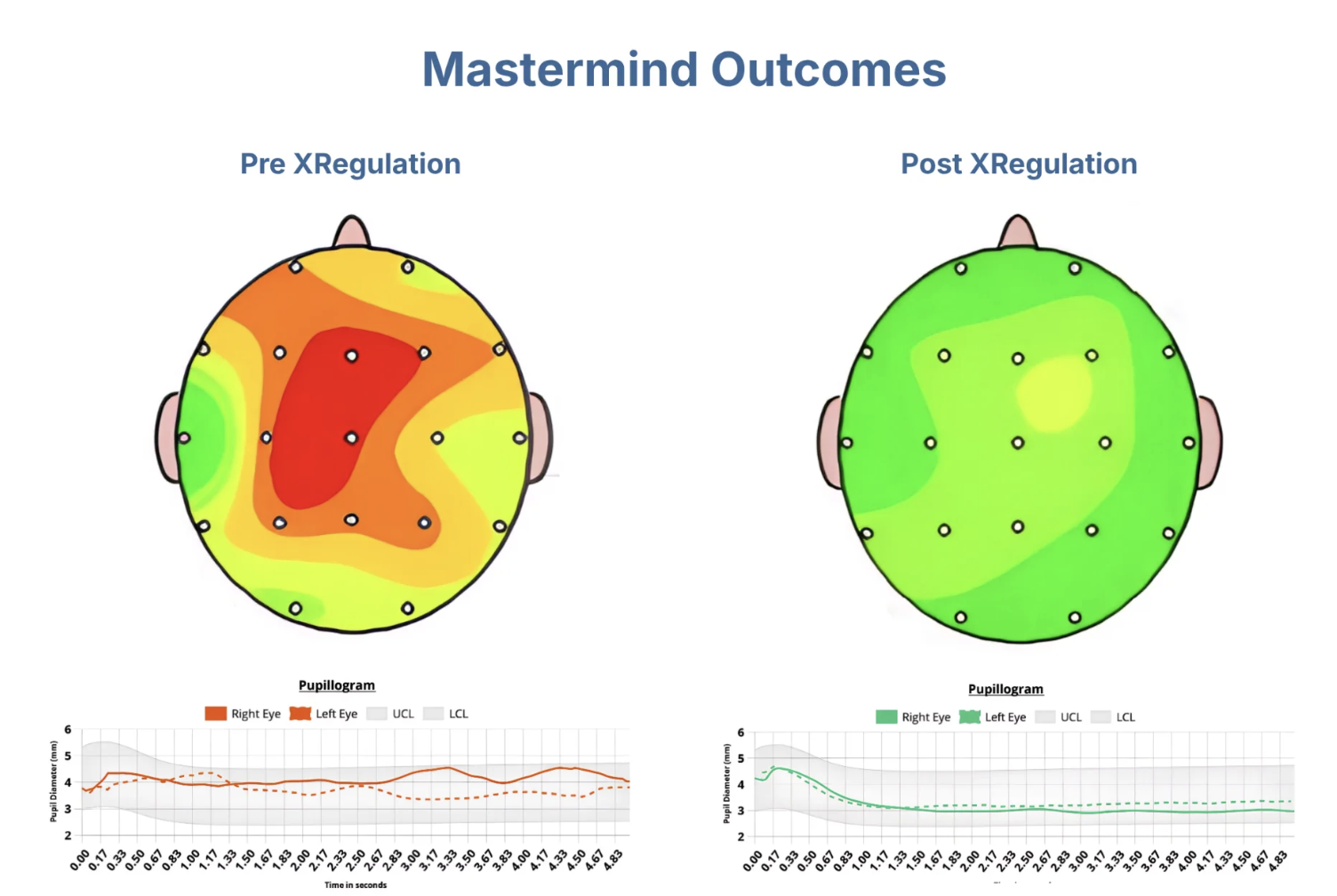
We collect pre and post snapshots to look for measurable changes in nervous system and brain activity patterns over the course of the program. This early data is de-identified and exploratory. It is not a clinical trial and results vary by person. These early patterns are consistent with increased nervous system capacity, including more resilient recovery and more reliable regulation.
qEEG Brain Mapping
Quantitative EEG can show changes in cortical activation patterns and connectivity signatures associated with focus, arousal, and recovery.
Pre Program Findings
Many participants show patterns consistent with high internal load, such as elevated fast wave activity in frontal regions and reduced stability across networks involved in focus, regulation, and recovery. These patterns can be associated with hypervigilance, rumination, and difficulty settling into a calm alert state.
Post Program Changes
Post program maps often show a shift toward more balanced activation patterns, improved organization across regions, and greater stability in rhythms associated with calm focus. These changes can suggest improved self regulation capacity and more efficient recovery after stress.
What This Means in Daily Life
Clearer thinking under pressure
Less mental fog and looping thoughts
Improved focus without grinding or forcing
More emotional steadiness and flexibility
Better downshifting into sleep and recovery
Pupilometry
Pupil dynamics can reflect autonomic state, cognitive load, and adaptability, including how quickly the system responds and recovers.
Pre Program Findings
Many participants show pupil response patterns consistent with reduced autonomic flexibility, such as a slower or smaller light reflex response and less variability across conditions. These patterns can be associated with chronic stress load, fatigue, and a nervous system that stays in high activation longer than it needs to.
Post Program Changes
Post program data often shows stronger and more responsive pupil dynamics, including improved light reflex metrics and increased variability. These changes can suggest improved parasympathetic engagement and a more adaptive balance between activation and recovery.
What This Means in Daily Life
Greater stress resilience and faster recovery
More consistent energy across the day
Less wired tired activation
Better cognitive stamina and sustained attention
More emotional bandwidth for relationships and creative work